How I found my own way with the bees
When I started beekeeping in 2021, I first worked in a very conventional way: reading, learning, listening to experienced beekeepers and doing many things as the textbooks describe. I had no plan to do everything differently. Quite the opposite – I wanted to learn how to do it properly first.
First by the textbook. Then came the questions.
In practice, however, I encountered situations that made me realise that some long-established beekeeping wisdom may be in the beekeeper’s interest but can later cause more problems for the bees than it solves. That does not mean everything that has been done for decades is wrong. But at some point I no longer wanted to know only what people do – I wanted to know why, and what the measure causes in the colony afterwards.
So I started to question routines deliberately. I kept some, changed others and today I avoid some altogether. Over the years this did not become a ready-made system from a book, but my own way of working with the bees.
Working with the bees
That is my real goal today.
I want to support the colonies and create the best possible conditions for them. If an unfavourable situation develops, I try to slow it early or counteract it. If intervention is necessary, I intervene. If the bees are managing a situation well themselves, I do not need to disturb them further out of habit.
That does not mean simply leaving the colonies to themselves. It means looking more closely and not carrying out a measure because it appears on a weekly schedule, but because it makes sense for this colony in this situation.
And the honey?
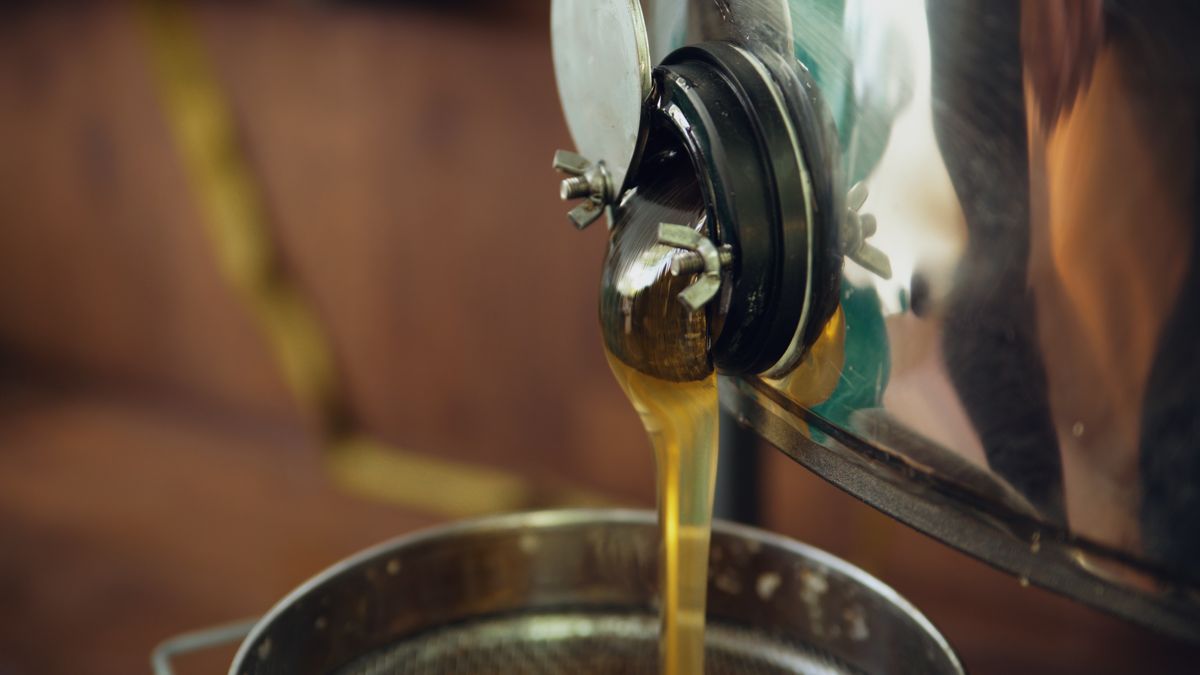
The process is deliberately straightforward here as well. I extract honey twice a year: the first harvest is around the end of the oilseed rape bloom, the second more often after the linden blossom. The exact timing depends on vegetation, nectar flow and the ripeness of the honey. Anything the bees bring in afterwards remains in the colony as winter stores.
After extraction, the harvested honey is bottled directly into jars, labelled and made ready for sale. There is no purchased honey, no blending with honey of other origins and no long intermediate storage. From the colony to the finished jar, the decisive steps remain with me.
What it has become today
My apiary today is the result of many small decisions and observations from recent years. Not every one of them is set in stone forever. If I see that something can be done better, the way I work can continue to evolve. What matters to me is that the bees and their actual condition remain the starting point – not a routine for routine’s sake.
I describe what this looks like in practice over the course of the year under Beekeeping approach.
From Honigmanufaktur to Herr Honig
In 2026, the gradual brand change begins from Honigmanufaktur Ingelheim to “Herr Honig”. During the transition, jars and individual listings may continue to carry the previous name. The name is changing – not the apiary behind it.
Why “Herr Honig”?
The name is deliberately uncomplicated. In the end, it is not about grand terms, but about bees, a manageable apiary and the honey that comes from it. That is exactly what “Herr Honig” is meant to put at the centre.
Address
Uli Müller
Unterböhl 16
55218 Ingelheim am Rhein